Understanding the Science Behind Livagen
At Crownwell Research, we believe scientific research should be understandable—not just for scientists, but for anyone interested in learning.
This article is a simplified review of a published scientific study examining how the peptide bioregulator Livagen may influence DNA activity inside cells. Rather than repeating the technical language used in the original publication, we’ve summarized the key findings in plain English.
Imagine Your DNA Is a Cookbook. Every cell in your body contains DNA. You can think of DNA as a giant cookbook filled with thousands of recipes. Each recipe tells the cell how to make something it needs to stay healthy and function properly.
When we’re young, those recipes are easy for the cell to read.
As cells age, however, some of the pages in the cookbook become harder to open. The instructions are still there, but the cell can’t access them as easily.
Scientists wanted to know whether Livagen could help make those instructions easier for the cell to read.
What Did the Researchers Discover?
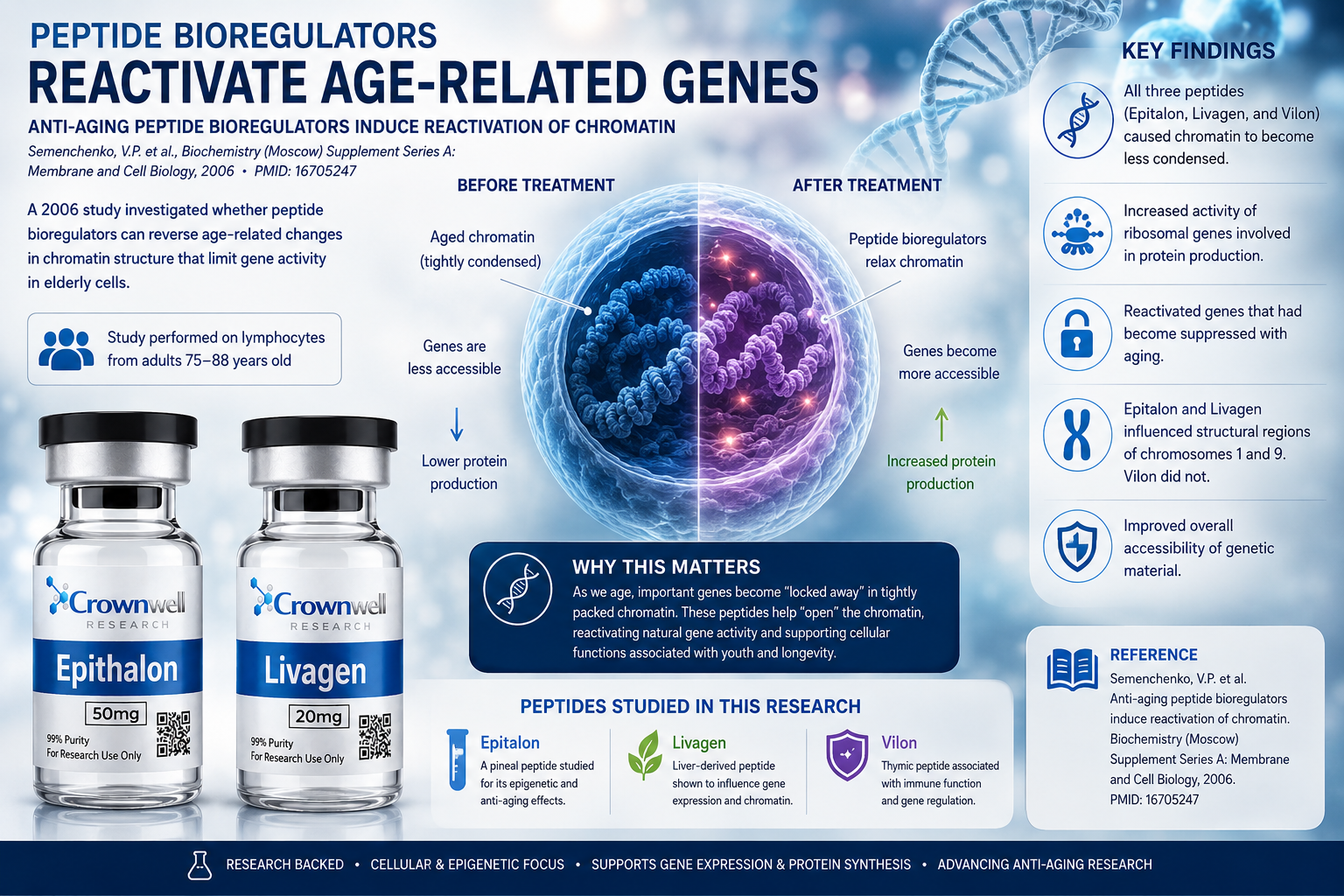
The researchers found evidence suggesting that Livagen may influence the way DNA is packaged inside the cell.
Instead of changing the DNA itself, Livagen appeared to help “open up” certain regions of DNA, making them more accessible. This could allow the cell to read important genetic instructions more efficiently.
The study also suggested that Livagen increased activity in genes involved in protein production. Proteins are essential molecules that help build, repair, and maintain tissues throughout the body..
In simple terms, the researchers observed signs that older cells behaved more like younger, more active cells after exposure to Livagen.
What Does This Mean?
The findings are important because they support the idea that very small peptide bioregulators may influence how cells use their existing genetic information.
Rather than rewriting DNA, these peptides may help cells gain better access to instructions that were already present.
This proposed mechanism has become one of the central ideas behind ongoing research into peptide bioregulators.
What the Study Does Not Prove
Although the results are promising, it’s important to understand the limitations.
This study does not prove that Livagen reverses aging or produces the same effects in humans. It provides laboratory evidence that helps researchers understand one possible mechanism of action, but additional studies are needed to determine how these findings translate into clinical settings.
As with all early-stage scientific research, the results should be viewed as part of an evolving body of evidence rather than definitive proof.
Why This Research Matters
More than twenty years after its publication, this study continues to be referenced because it introduced an important concept: that very short peptide bioregulators may influence gene expression by affecting how DNA is organized within cells.
Whether future research confirms or expands upon these findings remains an active area of investigation, but the study remains a foundational paper for scientists interested in peptide bioregulators.
Original Research
This article is an educational review of the following publication:
Khavinson VK, Lezhava TA, Monaselidze JG, et al. (2002). *Effects of Livagen peptide on chromatin activation in lymphocytes from old people*. Bulletin of Experimental Biology and Medicine, 134(4), 389–392. PMID: 12533768.
Readers interested in the complete scientific paper are encouraged to review the original publication available through PubMed.