This article is a reader-friendly summary of the scientific review “Thymosin α1 and Its Role in Viral Infectious Diseases: The Mechanism and Clinical Application,” published in the journal Molecules in 2023.
Thymosin Alpha-1, often shortened to Tα1, is a small peptide that has been studied for the way it interacts with the immune system. Instead of simply attacking a virus, Tα1 appears to help different parts of the immune system communicate and respond.
What Is Thymosin Alpha-1?
The thymus is a small organ in the chest that helps the immune system develop. It is especially important for producing and training T cells, which are immune cells that help the body recognize things that do not belong.
Thymosin Alpha-1 is a naturally occurring peptide connected to the thymus. It is made of 28 amino acids and plays a role in the development and activity of immune cells.
Researchers have been interested in Tα1 because it does not appear to affect just one part of the immune system. Instead, it can interact with several types of immune cells, including T cells, B cells, natural killer cells, macrophages, and dendritic cells.
Think of the immune system like a large emergency-response team. There are police officers, firefighters, dispatchers, and investigators. Thymosin Alpha-1 may act somewhat like a dispatcher, helping several parts of that system communicate and respond.
How Does Thymosin Alpha-1 Work?
Cells have tiny sensors on their surfaces called Toll-like receptors, or TLRs. These sensors help the immune system notice possible threats.
The review explains that Tα1 can interact with several of these receptors. This can activate communication pathways inside cells that tell immune cells when to become active, when to release signaling chemicals called cytokines, and how to respond to a possible infection.
Researchers have found that Tα1 may influence several important parts of the immune response.
It may help T cells develop and become more active. It may also increase the activity of natural killer cells, which are immune cells that can recognize and destroy certain damaged or infected cells.
Tα1 can also affect dendritic cells and macrophages. These cells help find unwanted material, process it, and alert other parts of the immune system.
Scientists have also studied Tα1’s effects on signaling systems such as NF-κB and MAPK. These pathways help control inflammation and immune activity.
Why Are Scientists Interested in It?
Many antiviral medicines work by directly interfering with a virus. Thymosin Alpha-1 is different.
Researchers believe that at least some of its effects may come from changing the way the immune system responds after an infection occurs.
The review describes two possible parts of this process. Tα1 may affect certain proteins on the surface of cells in ways that make viral replication more difficult. At the same time, it may strengthen parts of the body’s immune response by influencing T cells, natural killer cells, dendritic cells, and macrophages.
This makes Tα1 especially interesting to researchers studying immune regulation.
What Has Been Studied?
Thymosin Alpha-1 has been researched in connection with several illnesses, including hepatitis B, hepatitis C, HIV/AIDS, sepsis, SARS, and COVID-19.
The results have not been the same in every disease.
Some hepatitis B studies reported improvements in certain immune or clinical measurements, while other studies did not find a clear advantage.
Researchers studying hepatitis C found that Tα1 by itself was not very successful, although some studies combining it with other treatments produced better results.
Research involving HIV has been much more limited, and there is not enough evidence to show that Tα1 works as a treatment by itself.
What Did Researchers Find About COVID-19?
Scientists became especially interested in Thymosin Alpha-1 during the COVID-19 pandemic because serious COVID-19 infections can affect both immune cells and inflammation.
Some studies suggested that Tα1 might help restore certain T-cell populations or improve some outcomes in seriously ill patients.
Other studies did not find the same benefits.
For example, some researchers found no improvement in the recovery of CD4+ and CD8+ T cells. Other studies found that an apparent difference in mortality disappeared after researchers adjusted for other factors that could have influenced the results.
Because the studies produced conflicting results, the review’s authors concluded that the safety and effectiveness of Tα1 for COVID-19 could not yet be determined with confidence. They called for larger and better-controlled studies.
The Bigger Picture
The most interesting part of Thymosin Alpha-1 research may not be whether the peptide can attack a particular virus.
It is the way the peptide appears to communicate with many different parts of the immune system.
The authors describe Tα1 as an immunomodulator. In simple terms, that means it can change or guide immune activity instead of simply switching the immune system “on.”
That difference matters because a healthy immune response requires balance. An immune response that is too weak may not deal with a threat properly, while an immune response that is too strong can create excessive inflammation.
Scientists are still working to understand exactly where Thymosin Alpha-1 fits into that balance.
Thymosin Alpha-1 Is Part of a Much Larger Peptide Research Field
Thymosin Alpha-1 is only one example of how different peptides are being investigated for very different biological functions.
Other research compounds focus on completely different systems.
Retatrutide is being studied because of its activity at three different hormone receptors: GLP-1, GIP, and glucagon receptors. That makes Retatrutide research very different from the immune-focused research surrounding Thymosin Alpha-1.
Researchers interested in this area can view our GLP-R mg product page for research-material specifications and available documentation.
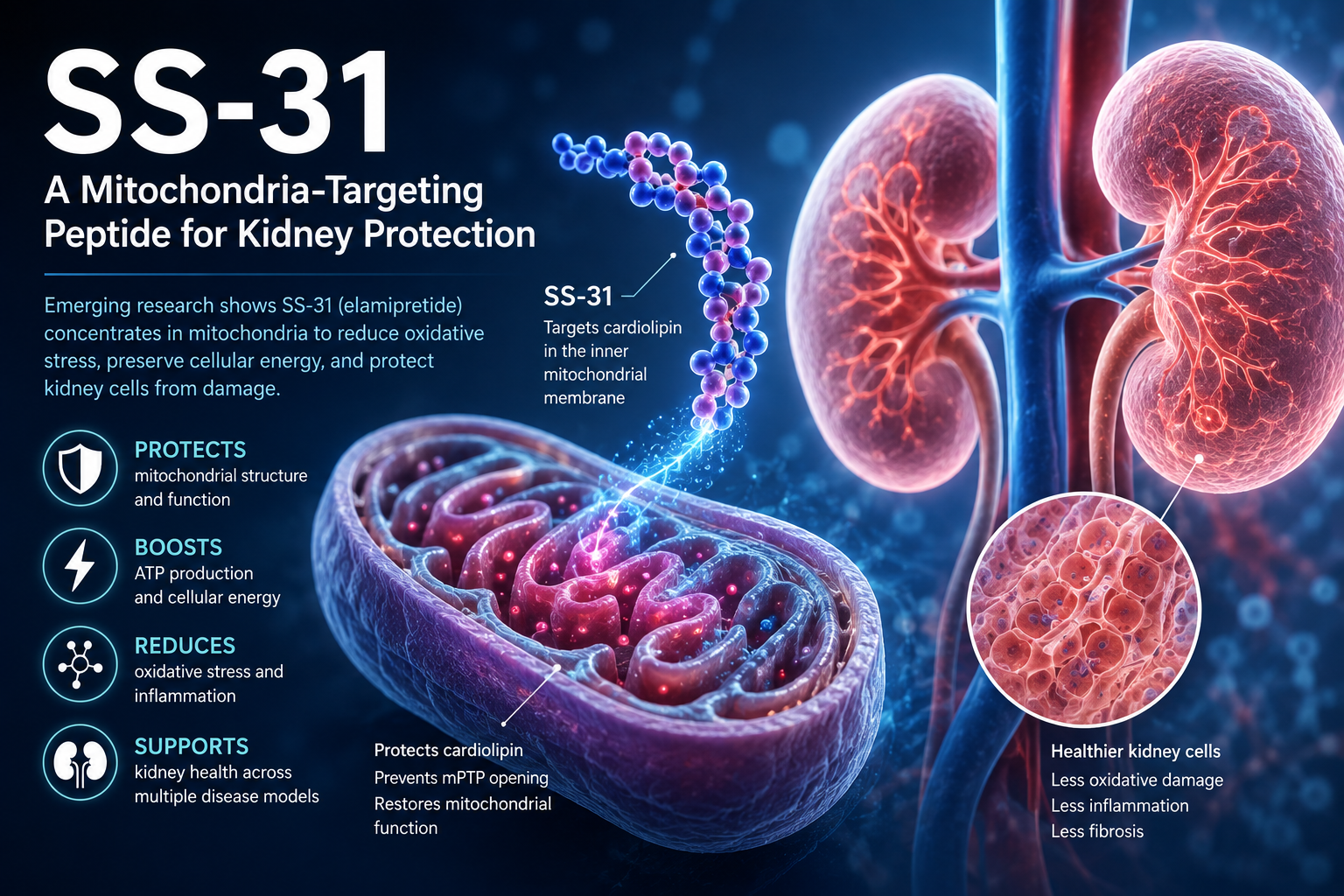
SS-31 is another peptide from a very different area of research. Rather than focusing primarily on immune signaling, SS-31 has been investigated for its interactions with mitochondria, the structures inside cells that help produce energy.
Researchers studying mitochondrial peptide science can also view our SS-31 research material and supporting documentation.
These compounds should not be considered interchangeable. Thymosin Alpha-1, Retatrutide, and SS-31 interact with very different biological systems, which shows just how broad modern peptide research has become.
What Is the Main Takeaway?
Thymosin Alpha-1 is an unusual peptide because researchers have found that it can interact with several different parts of the immune system at the same time.
Studies suggest that it can influence T cells, natural killer cells, macrophages, dendritic cells, Toll-like receptors, cytokines, and several important cellular signaling pathways.
Clinical research has produced promising findings in some areas and disappointing or uncertain findings in others.
For now, Thymosin Alpha-1 remains an important subject of research because it gives scientists another way to study one of biology’s most complicated questions:
How does the immune system know when to fight, how strongly to respond, and when to stop?
Read the Original Research
Read “Thymosin α1 and Its Role in Viral Infectious Diseases: The Mechanism and Clinical Application” in Molecules.
NEXT: Retatrutide Reconstitution: A Research Guide to Concentration, Mixing, Storage, and Handling